Lightning nodes are more profitable now. But not how you think.
Lightning node profitability in 2026: routing fees, liquidity leasing, consolidation and why scale now matters more than experimentation.
Why are we suddenly seeing more operators actually claim they're making real money from Lightning? Honestly, the math has shifted enough that it's not just theoretical anymore - but that doesn't mean it works for anyone with a node.
We looked at the network data recently (via Mempool), and here's where it sits now. 5.3k BTC in total capacity across 17.3k nodes, 40.8k channels. The network shows consolidation - capacity and nodes both down slightly from peaks. Capacity is meaningfully concentrated: the top 10% of nodes hold roughly 70.94% of total public capacity. Worth noting - this is concentration by individual nodes, not by entity. You've got multiple Bitfinex nodes in that top tier, plus several LNBiG hubs, so consolidation by actual operator is probably even tighter than the node numbers suggest.
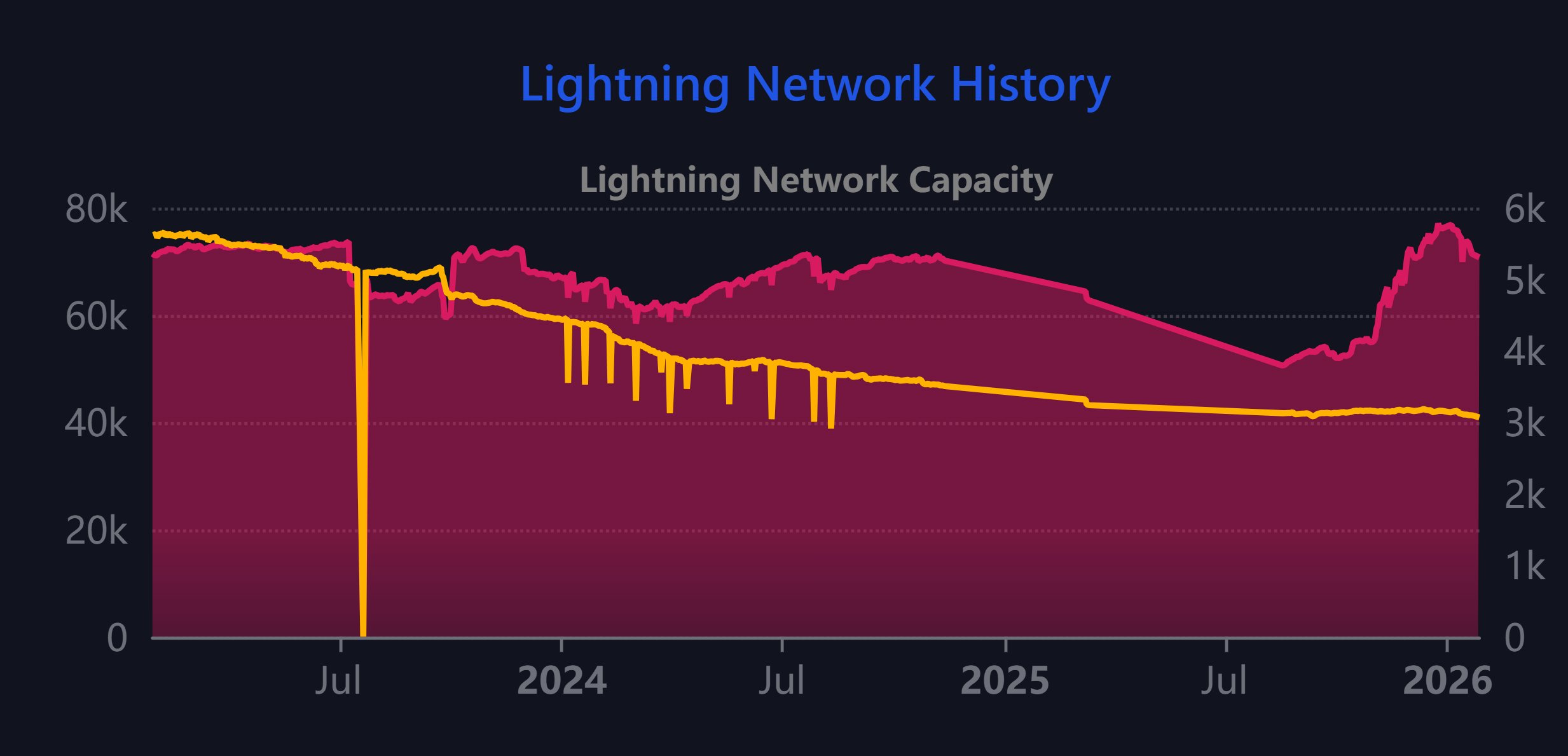
Lightning Network History: capacity trends and consolidation into 2026.
Here's the uncomfortable part: we keep seeing the same pattern. Small nodes barely cover electricity. Optimized nodes with actual capital deployed make real returns. The gap between them isn't just about uptime or better tools - it's about who has the capital to deploy and the patience to automate.
How operators actually earn on Lightning
Three revenue paths exist. First: routing fees. When a payment passes through your channel, you take a tiny cut (maybe 1 sat plus 0.0001% per transaction). Simple enough - you're basically a payment hop.
Second path - and this is where we started noticing patterns - is channel capacity leasing. Platforms like Lightning Pool and Magma let operators with idle inbound capacity sell it. You're lending liquidity for yield instead of hoping routing fees accumulate. Some merchants do this too (generate yield from their payment flows while accepting payments). Though adoption is still relatively limited.
Third path: LSP models. Companies like Voltage and Alby provide liquidity tooling and uptime services. Exchanges do this at scale too - reports roughly 15% of Bitcoin transactions on Coinbase now move over Lightning. At exchange scale, balanced channels handle settlement flows and internal routing becomes meaningful. Idle liquidity gets deployed elsewhere.
So which path works? Depends on what capital you can deploy and how much you want to automate. Most operators pick one and struggle with the others.
The optimization layer
We've looked at what separates the $5/month nodes from the $300/month ones, and it comes down to three things. Maybe it's obvious in hindsight, but most operators miss it anyway.
First: dynamic fee tuning. Lightning Terminal's Autofees adjusts your rates based on past earnings history, updating every three days. When routing opportunities spike, rates rise over time. When traffic drops, they lower. You're not manually tweaking every week - the system handles it. Does it work? The data suggests yes, though honestly the actual impact depends on your channel positioning.
Second: channel rebalancing. Balanced channels (inbound roughly equal to outbound) route more volume. When you're imbalanced, routing paths disappear. Tools like Loop let you move funds between on-chain and off-chain, Autoloop does it automatically when routing fees exceed on-chain costs. Without this, we've seen operators leave significant yield on the table - sometimes half their potential revenue.
Third: peer selection. You're not connecting to random nodes. Professional operators score peers by uptime, connectivity maturity, channel age. Diversifying across 10-30 well-chosen connections spreads risk and opens more routes. Does this actually matter? We think it does. Smaller operators often just point to whoever has liquidity available, which is fine for learning but brutal for profitability.
Raw capacity and uptime matter too. Bigger channels earn more. Always-online nodes earn more. Block reported something like 9.7% annual yield in 2025 from pure routing optimization - if you deploy real capital, stay online, and tune aggressively.
The network is consolidating
Here's what's harder to admit: capacity is concentrated. The top 10% of nodes hold roughly 70.94% of public capacity. This creates a dynamic where bigger nodes accumulate fees faster, which funds expansion, which attracts more routing. Smaller nodes route less and face constant fee pressure. It's not sinister - it's just how liquidity concentrates. And because entities like Bitfinex and LNBiG run multiple nodes, the real consolidation by operator is probably even tighter.
Fee markets are uneven. Demand spikes during Bitcoin volatility or promotional periods shift optimal rates overnight. You need to stay on top of this or you're competing blind. Channel management costs add up too - on-chain fees for opening, closing, rebalancing eat into margins, especially in high-fee months. You're managing actively or you're losing money passively.
Also: the network topology is shifting. Channel splicing and dual funding let operators resize channels off-chain now. Reduces churn, which is good. But it means fewer obvious routing opportunities on public graphs. Smart operators are moving to private channels and multi-path payments instead - routes that don't show up in topology explorers but actually move volume.
Where we actually see this working
Some businesses are experimenting with Lightning at scale, though the economics play out differently depending on capital and positioning.
Merchants need inbound capacity to receive payments, and some layer liquidity operations on top - generating yield from their flows while accepting payments. LSPs like Voltage and Alby built subscription models around this: merchants pay flat fees for guaranteed uptime and routing, LSPs guarantee low fees. It's recurring revenue, which scales differently than per-transaction chance.
Exchanges are more aggressive - Coinbase reported roughly 15% of Bitcoin withdrawals go via Lightning, and at that scale, balanced channels handle settlement flows and internal fee arbitrage becomes meaningful. Idle liquidity gets deployed elsewhere.
The real path forward is node-as-a-service. These companies bundle capital, infrastructure, fee optimization, liquidity management into a single product. Operators can't crack profitability at small scale, so companies productize the whole stack instead. Block's yields at 9.7% suggest that if you have the capital and automation, the economics work. That's basically where the ecosystem is moving.
What's happening right now
We're seeing a bifurcated network form. One side: professionalized operators treating nodes like businesses - Amboss, Voltage, Alby, Block, institutional players aggregating capital and automating hard. Other side: smaller nodes slowly losing relevance as consolidation continues.
The gap between top performers and the median is widening. If you're genuinely serious about running a Lightning node for revenue - not as an experiment, actually for income - approach it like any other capital deployment. Expect 6-12 months to break even. Design for scale from day one. Automate everything. The operators generating real income understood this wasn't passive from the start.